


What is matcha tea?
The main difference from traditional green tea lies in its meticulous cultivation and consumption process. Weeks before harvest, the tea plants (Camellia sinensis) are covered to protect them from direct sunlight; this process stimulates the production of chlorophyll and amino acids, giving it its characteristic color and umami flavor.
Subsequently, the tenderest leaves are harvested, dried, and slowly ground in stone mills. When preparing matcha, instead of simply infusing the leaves and discarding them, the powder is whisked into the water to ingest the entire leaf, allowing the body to absorb 100% of its nutrients, vitamins, and antioxidants.
What are the benefits of matcha?
Matcha is often considered a superfood due to its high concentration of bioactive compounds. Because the entire tea leaf is consumed, it provides a rich source of antioxidants, particularly catechins such as EGCG, which help protect cells against oxidative stress.
It also contains caffeine and L-theanine, a natural combination that may support focus, mental clarity, and sustained energy. For this reason, many people incorporate matcha into their daily routine as a balanced alternative to other caffeinated beverages.
Its antioxidants and plant-based nutrients may also contribute to maintaining healthy-looking skin and hair by helping protect cells from environmental stressors and premature aging. While it is not a substitute for a balanced diet, matcha can be an excellent addition to a healthy lifestyle.
How do you prepare a perfect matcha latte?
- Sift approximately 2g of matcha (two heaped bamboo scoops) into your bowl (chawan).
- Pour in about 50 ml of hot water (maximum 80 ºC, never boiling, to avoid burning the tea).
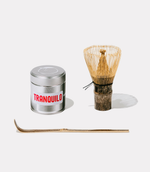
- Whisk vigorously with the chasen (bamboo whisk) using zig-zag movements ("W" or "M") for about 15-20 seconds until a dense, lump-free foam layer is created.
- Finally, pour the mixture over your preferred milk or plant-based drink (cold with ice or hot).
How should it be stored to maintain its freshness?
It is essential to keep matcha in a cool, dry place, protected from light. We recommend storing it in the refrigerator and ensuring the tin is hermetically sealed to preserve its vibrant color and antioxidant properties.
Does matcha tea contain gluten?
No, our matcha tea is a naturally gluten-free product.
Does it contain added sugars?
No. Our matcha is made from 100% finely ground green tea leaves. It does not contain any sugars, sweeteners, colorants, additives, or preservatives of any kind.
Is it suitable for vegan and vegetarian diets?
Absolutely. As it is a product of strictly plant-based origin, it is ideal for people following a vegan or vegetarian diet.
How much caffeine does it contain compared to coffee?
A typical serving of matcha tea (2g) contains approximately 60 to 70 mg of caffeine, which is about half the caffeine found in a standard cup of coffee. However, thanks to the presence of L-theanine (a unique amino acid), energy is released gradually and sustained (for 4 to 6 hours), avoiding jitters or sudden energy crashes.
Does matcha tea break a fast?
Prepared with only water, matcha tea does not break a fast, as its caloric content is practically zero (approximately 3 calories per gram). If milk or plant-based beverages are added, the fasting state would be interrupted.
What are the shipping costs?
- Spain and Portugal: €3.95
- Germany and France: €4.95
- Italy, Belgium, Netherlands: €5.95
- United Kingdom: £6
- Croatia, Czech Republic, Denmark, Finland, Greece, Luxembourg, Malta, Slovakia, Slovenia, Sweden, Ireland: €6.95
- Austria, Bulgaria, Estonia, Hungary, Latvia, Poland, Romania: €12.95
- Norway, Switzerland: €12.95
We offer free shipping for orders over €49 in Spain and Portugal, and for orders over €75 in Germany, France, Italy, Belgium, and the Netherlands.
How long will my order take to arrive?
Once processed at our facilities, the estimated delivery time is 1-3 business days for the Iberian Peninsula and 3-7 business days for the rest of Europe.
What is the deadline to request a refund?
You have a period of 14 calendar days from the receipt of your item to exercise your right of withdrawal and request a refund.
What conditions must the article meet?
To be eligible, the item must be in the same condition as received: unused, unworn, with all original tags attached, and in its intact original packaging. It must also have the receipt or proof of purchase.
Note: There are exceptions for hygiene reasons; returns are not accepted for perishable goods (such as food), personalized products, gift cards, or sale items.
How do I start the return process?
You must submit your request directly through our returns portal. Once the request has been reviewed and approved, we will send you the shipping label along with detailed instructions.
Do returns have any cost?
Yes, the customer is responsible for return shipping costs, as well as the cost of receiving, quality control, and relocating the product. This fee is:
- €5 for Spain and Portugal.
- €10 for other countries.
Original order shipping costs are non-refundable.
What happens if there's a problem with the delivery?
If the order is returned because the address provided was incorrect, incomplete, or due to not being collected within the stipulated days, the cost of reception will be deducted from the refund.
In the event of receiving a damaged, defective, or incorrect item, please contact us immediately at info@tranquilomatcha.com to assess the situation and offer you a solution.
What payment methods do you accept?
To facilitate your purchase process quickly and securely, we accept:
- Credit and debit cards: Visa, Mastercard, and American Express.
- Express payments: Apple Pay and Google Pay.
- PayPal.
- Klarna (for flexible payment options).
Is it safe to enter my bank details on your website?
Completely secure. Our payment process is encrypted under the highest security standards (SSL certification). Please rest assured that Matcha does not store your card details at any time during or after the transaction.